

The Format Now Sitting Above UK Car Searches Arrived as a Pilot Almost Nobody Was Invited To
Vehicle ads didn't reach British dealerships through a general release. They arrived in early 2024 as a restricted programme run with a handful of agencies, Localise among them, at a point when most of the trade had never heard of them. That's shaped who understands...
read more
Melbourne’s January Heat Records Are Forcing a Rethink on Window Shading
Victoria hit an all-time temperature record this past January, and the number that stuck with most homeowners was not the heat itself but how long it lasted. A single scorching afternoon is manageable. A week of it, back to back, is what actually breaks air...
read more
A Record Apartment Pipeline Is Complicating the Gold Coast Property Search
The Gold Coast apartment market entered the second half of 2026 with an unusual combination of strong sales and an unprecedented number of active projects. On the surface, that sounds like a buyer’s market with abundant choice. In practice, a long development list can...
read more
The Workplace Fairness Act Is Quietly Rewriting What Mindset Training Has to Deliver in Singapore
Singapore passed the Workplace Fairness Act in 2025, and by the end of 2027 it will be enforceable law, not a leadership preference. Employers with 25 or more staff — roughly 75 per cent of Singapore's employers — will be legally required to run a formal grievance...
read more
Las Vegas Set Record March Heat This Year, Pushing Patio Cover Season Weeks Earlier
Spring in Las Vegas used to be the payoff for surviving the last summer. A run of perfect 75-degree afternoons before the furnace kicked back on in May. In March 2026 the payoff never showed up. Instead an early-season heat wave parked itself over the Southwest, and...
read moreBusiness

Essential Tech That Every Business Should Have
One of the most significant and most important impacts of technology is its effect on small businesses. Through the use of these pieces of tech, entrepreneurship's potential is elevated, greater ease is provided, and business owners become more critical when it comes...

The Uncontrollable Greed of Apple
Apple Has Always Been After the Money Apple devices are expensive, but the company’s sales are still soaring higher year after year. The reason why people are sticking to apple because of its user experience and how the ecosystem works. The fluidity of iOS is...
Cloud Tech

Most common uses of Cloud Computing & Network Monitoring
Cloud computing, these days, is expanding its aggressiveness by lessening the cost, versatility, more noteworthy adaptability, and ideal usage of assets. Here we disclose to you some imperative fragments where distributed computing is utilized to achieve the business...
Featured

Important Pointers to Keep in Mind When Buying New Gadgets – A Quick Look
Buying a new gadget or accessory can be tricky, especially if you're not sure what type you need. For example, it can be difficult to determine the best time to buy a smartphone or laptop. However, there are some things that you can do to reduce your costs and make...
read more
Keeping Up with the Latest Gadget Trends Today – How to Make It Hassle-Free
Keeping up with the latest gadget trends is vital for businesses and individuals. The market is always changing, and companies need to keep up with the latest trends to remain competitive. Listed below are some of the most popular tech gadgets for 2019. We hope that...
read more
Melbourne’s January Heat Records Are Forcing a Rethink on Window Shading
Victoria hit an all-time temperature record this past January, and the number that stuck with most homeowners was not the heat itself but how long it lasted. A single scorching afternoon is manageable. A week of it, back to back, is what actually breaks air...
read more
The Workplace Fairness Act Is Quietly Rewriting What Mindset Training Has to Deliver in Singapore
Singapore passed the Workplace Fairness Act in 2025, and by the end of 2027 it will be enforceable law, not a leadership preference. Employers with 25 or more staff — roughly 75 per cent of Singapore's employers — will be legally required to run a formal grievance...
read moreMost Recent Posts
Why a $3.7 Billion CareCredit Year Has Patients Rethinking How to Finance Dental Implants
Implant treatment is a significant expense, and for many people the financing conversation happens in the same chair as the clinical one. That overlap is exactly what consumer advocates have spent the last couple of years warning about.
The product at the center of the concern is the medical credit card, offered at the front desk as an easy way to spread out the cost. The fine print is where the trouble lives.
Understanding how these products work is part of making a sound decision about paying for dental work, every bit as much as understanding the procedure itself.
The Scale of the Business
Medical credit cards are not a niche. One issuer’s parent company reported making $3.7 billion in interest and fees from its CareCredit accounts in a single year, according to reporting on the industry.
Dentistry is the largest single market for these cards. The cards are accepted at hundreds of thousands of provider locations, and they are marketed to the offices themselves as a way to get paid quickly and to help patients say yes to costly care.
The concentration in dentistry is striking. By one consumer-law analysis, the overwhelming majority of medical-card users reported using them for dental work, far more than for any other category of care. When advocates talk about this product, they are largely talking about a dental-office phenomenon.
The default rate tells its own story. Federal analysis found that a large share of cardholders with weaker credit fail to clear the balance before the promotional window closes, which means the deferred interest triggers for exactly the people least able to absorb it. The product’s economics depend, in part, on a meaningful fraction of users missing the deadline.
The mechanism that draws people in is the promotional period, often described as no interest if paid in full within a set window. It sounds like zero percent financing. It is not the same thing.
The distinction is deferred interest. With a true zero-percent offer, unpaid interest is forgiven. With deferred interest, if any balance remains when the promotional window closes, interest is charged retroactively on the entire original amount.
Where the Trap Springs

The retroactive piece is what catches people. A patient who pays off most of a balance but misses the deadline by a small amount can be hit with interest calculated as though they never paid down anything at all.
Regulators have flagged this structure as a consumer harm, noting that interest rates on these cards often run well above standard credit cards, in some cases above thirty percent. Federal analysis found that a substantial share of cardholders with weaker credit fail to clear the balance before the promotion ends.
The point-of-service setting makes it worse. People sign up when they are stressed and focused on care, not shopping carefully for credit terms.
There is also a documented pattern of patients being steered toward these cards when they might have qualified for a provider’s own payment plan or financial assistance instead.
The downstream consequences are not hypothetical. One analysis of bankruptcy filings in Oregon found that a single medical credit card was the most frequently listed medical debt holder in the state. Debt incurred for care has a way of outliving the care itself.
This is not the first time the product has drawn official attention. More than a decade ago, regulators forced the same major issuer to refund tens of millions of dollars to consumers over enrollment tactics that left people unaware of the deferred-interest terms. The structure that caused problems then is largely the structure still in use.
One more wrinkle is worth knowing. These card agreements often include arbitration clauses, which can make it harder for a wronged consumer to band together with others or pursue claims in court. The terms are stacked toward the issuer in more ways than the interest rate alone.
Smarter Ways to Approach the Cost
None of this means a person cannot use a medical credit card responsibly. It means going in with eyes open and a realistic plan to clear the balance before the deferred interest triggers.
It also means asking about alternatives before signing anything. Many practices offer direct, in-house payment arrangements that do not carry the retroactive-interest mechanism.
Health savings and flexible spending account funds can cover eligible dental expenses without any financing cost. For larger balances, a conventional personal loan at a lower fixed rate can beat a deferred-interest card outright.
The broader lesson from the regulatory scrutiny is to separate the two decisions. Choose the treatment with the clinician, then make the financing decision on its own terms, ideally after leaving the office and reading the agreement.
A concrete habit helps here. Ask for a written, itemized estimate of the treatment cost before any conversation about how to pay for it. With a real number in hand, a person can compare financing paths calmly at home, weigh an in-house plan against a card against a personal loan, and avoid deciding under the soft pressure of a front desk waiting for an answer.
A reputable practice will lay out the real cost and the genuine payment options without pressure. For something as substantial as full-mouth implant work, the financing path deserves the same scrutiny a patient would give any major purchase, and the front desk is not always the place to make that call in a hurry.
This is general information rather than financial advice, and anyone weighing a specific financing product should review the actual terms and consider speaking with a qualified financial advisor.
How Motorized Louvered Pergolas Changed the Backyard Shade Decision for San Diego Homeowners
For years the pergola-versus-cabana debate had a clean dividing line. Pergolas were open and let sun through; cabanas enclosed a space and kept weather out. A newer category has blurred that line, and it is reshaping how homeowners think about shade. Bioclimatic pergolas, the motorized louvered systems that adjust on demand, are now a fast-growing segment, with the global market projected to reach $821.2 million by 2030.
The appeal is simple once you see one work. A bioclimatic pergola has a roof of aluminum louvers that tilt, rotating from fully open to fully closed at the touch of a control, with many systems shedding rain when shut. That single capability collapses much of the old trade-off between a pergola and a cabana.
The Old Trade-Off, and Why It Existed
A traditional fixed pergola is a compromise by design. Its open slats filter sunlight, which is lovely in the morning and inadequate at two in the afternoon in July. Owners patched the gap with climbing vines, fabric tops, or retractable canopies, each of which helped a little and aged in its own way.
The cabana solved the shelter problem by giving up openness entirely. You got privacy and protection, but you also got a visually dominant structure that consumed more yard and cost considerably more to build. For a lot of homeowners, neither option was quite right.
That is the friction the louvered system targets. By making the roof adjustable, it offers a pergola’s openness when you want light and air and something close to a cabana’s shelter when you close the louvers against sun or a passing shower. The structure adapts to the hour instead of forcing a single permanent choice.
Industry analysts describe these as climate-responsive structures built with motorized adjustable louvers and, in higher-end versions, sensors and weather controls. The category sits between the two traditional answers, which is exactly why it has grown into its own market rather than staying a niche upgrade.
Why the Shift Lands Hard in Southern California

The bioclimatic concept matters more in some climates than others, and Southern California is squarely in its sweet spot. The region’s long, sunny, dry stretches are precisely the conditions where a fixed pergola underperforms and a homeowner wants to dial in shade through a hot afternoon.
Coastal exposure adds a second reason. Aluminum, the dominant material in these systems, resists the rust and corrosion that punish other metals near salt air, which is the same reason aluminum already gets recommended for fixed pergolas on the coast. The louvered systems inherit that durability advantage.
There is an energy and comfort angle, too. By modulating sun and airflow, these structures function as passive cooling for the patio beneath them, keeping an outdoor room usable across more of the day and year. In a place where outdoor living is a central part of how homes are used, that extended usability is the whole value proposition.
The catch is cost. Motorized louvered systems run well above a simple fixed pergola, and adding sensors and automation pushes the figure higher again. For budget-sensitive buyers, that premium is a genuine barrier, and a well-built fixed pergola with a good canopy remains a sensible answer.
Where This Leaves the Classic Decision
None of this makes the old pergola or cabana obsolete. A fixed wood pergola still offers warmth, lower cost, and a classic look that blends into a garden. A cabana still wins where the real need is privacy, enclosure, and a poolside room with storage. The louvered system did not replace those; it added a third path.
What changed is the framing of the decision. The question used to be open versus enclosed, a permanent commitment made at install. Now there is an in-between that lets a homeowner defer that commitment to a daily setting, at the price of a more complex and more expensive structure.
For homeowners weighing the options, the honest filter is use and budget. If you want shade you can tune through the day and you can absorb the premium, a bioclimatic system is compelling. If cost is the constraint or the look you want is rustic and planted, a fixed pergola still makes sense. If privacy and poolside shelter are the goal, the cabana keeps its edge.
The market trajectory suggests these adaptive structures will keep taking share as prices ease and the technology becomes familiar. But the underlying lesson is not that one structure won. It is that the backyard shade decision now has more than two honest answers, and the right one still depends on the lot, the climate, and the wallet in front of it.
It is also worth being clear-eyed about maintenance and complexity. A fixed wood pergola can be repaired by almost any handy owner, while a motorized louvered system introduces motors, controls, and sometimes sensors, all of which are points that can eventually need service. The adaptability is real, but so is the added machinery behind it.
For most homeowners the decision comes down to how often they would actually use the adjustability. Someone who entertains across seasons and chases shade through long afternoons will get daily value from louvers that move. Someone who uses the yard mainly on mild evenings may find a simpler structure delivers nearly the same comfort for a fraction of the outlay.
What the $940-Million July Flood Revealed About Aging Toronto Roofs
When people think about flood damage, they picture basements and storm sewers, not roofs. But the catastrophic July 2024 rainfall that swamped the GTA was also a stress test for the part of the house at the top, and a lot of roofs did not pass it.
A roof can shed ordinary Toronto rain for years and quietly hide its weak spots. A true deluge does not give it that luxury. It finds every gap at once, which is why a single extreme storm can produce leaks in homes that had never leaked before.
The scale of the event
The July flash-flooding event alone caused $940 million in insured damage, part of a summer that pushed Ontario’s flood losses past a billion dollars and ranked among the costliest on record.
Rain that intense does not just pool on the ground. It overwhelms roof drainage, backs up behind clogged valleys and gutters, and pressurizes every seam and penetration on the roof simultaneously. Water that would normally run off harmlessly instead gets pushed sideways and upward into places it is never supposed to reach.
Where roofs leak in a deluge

The failure points are predictable, which is the useful part. On flat and low-slope roofs, common across Toronto’s housing stock and rear additions, the first culprit is drainage that is undersized or blocked, so water ponds instead of leaving.
On sloped roofs, the weak spots are worn flashing where the roof meets walls and chimneys, and the penetrations around vents, pipes, and skylights where old sealant has dried out and cracked. Intense rainfall finds those faster than a homeowner ever could. The first sign is often a ceiling stain that appears overnight, far from the actual point of entry, because water travels along the deck before it drops.
Why drainage is the overlooked detail
On a flat or low-slope Toronto roof, the difference between a dry house and a flooded one in a cloudburst is drainage detailing, and it is the part of the job that is easiest to under-build because it is invisible when the sun is out.
Proper slope toward the drains, adequately sized scuppers and drains, clean valleys, and well-terminated membrane edges are what keep water moving off the roof rather than through it. A roof can look immaculate and still fail in a downpour if the water has nowhere fast enough to go.
Because this detailing is technical and unglamorous, it is exactly where bargain installs cut corners. Homeowners with flat or low-slope roofs are wise to choose an installer with genuine flat-roofing experience rather than a general crew that does flat roofs occasionally, since the membrane and drainage work is a real specialty.
Building for the storms that are coming
These once-rare downpours are becoming a regular feature of Toronto summers, which changes the standard a roof should be built to. Designing drainage and flashing for the storm of the decade, rather than an average rain, is no longer over-engineering.
For a homeowner, the takeaway after a $940-million July is straightforward: when you re-roof, treat drainage, flashing, and membrane detailing as the main event, not an afterthought. The roofs that stayed dry in 2024 were the ones built that way, and the next deluge will sort the rest.
Why As Many As Four in Ten Denture Wearers Develop Sores, and What That Reveals About Fit
A denture is supposed to make life easier, not leave the mouth raw. Yet a surprising number of wearers quietly live with sore spots, irritation, and inflammation, often chalking it up to something they simply have to tolerate.
They do not. Most of that discomfort is a fixable signal about how the appliance is fitting, and ignoring it tends to make matters worse.
How Common the Problem Really Is
The numbers are higher than most people assume. A 2025 retrospective study of elderly denture wearers found that more than a third had denture-related oral lesions, and the figure climbed with the age of the appliance.
Among people who had worn the same dentures for more than a decade, the lesion rate rose to nearly 55 percent. Complete-denture wearers fared worse than partial-denture wearers, a difference the researchers tied to the larger area of contact and longer wear.
Denture stomatitis, an inflammation of the tissue beneath the appliance, is the most common of these problems. Broader reviews put its prevalence across denture wearers in a wide band, but consistently high.
The pattern across studies is hard to miss. The longer a denture stays in service without adjustment, the more likely the mouth underneath it is to suffer.
Why Fit Sits at the Center of It

These lesions are not random bad luck. Ill-fitting dentures are a recurring thread running through the research.
When an appliance no longer sits snugly, it shifts and rubs during eating and speaking. That repeated mechanical irritation inflames the tissue and creates openings for microbial growth.
An old or poorly fitting denture also traps debris and moisture against the gums, an ideal environment for the organisms behind denture stomatitis. Poor cleaning habits compound the problem, but fit is frequently the underlying driver.
The mouth, in other words, is reporting on the hardware. Persistent sores are less a hygiene verdict than a fit problem asking to be addressed.
The Case for Acting Early
The instinct to wait it out is understandable and usually wrong. Minor irritation left alone can progress into more stubborn lesions and tissue changes that are harder to reverse.
Catching it early generally means a straightforward fix. An appliance that has loosened or worn can often be repaired, adjusted, or refitted rather than replaced outright.
That distinction matters for cost and comfort alike. A timely repair restores fit and lets the inflamed tissue settle, while delay can push a patient toward a full remake.
There is also a quality-of-life dimension. Constant low-level soreness wears on a person’s willingness to eat normally and speak freely, and resolving it tends to bring an outsized improvement in daily comfort.
What the Sores Are Really Telling You
The lesson buried in the data is that denture discomfort is information, not an inevitability. A denture that hurts is usually a denture that has stopped fitting the way it should.
That is good news, because fit is something professionals can correct. The mouth changes over time, and appliances are meant to be maintained, not endured until they fail.
For anyone resigned to chronic sore spots, the takeaway is simple. Those sores are a prompt to have the fit checked and the appliance repaired, not a permanent feature of life with dentures.
Four in ten wearers developing lesions is a striking statistic. It is also an avoidable one, and the path to avoiding it usually starts with taking the discomfort seriously enough to get the appliance looked at.
The August Storm That Flooded Mississauga and Etobicoke Put Roof Drainage in the Spotlight
The summer of 2024 delivered two catastrophic floods to the GTA in as many months, and the August event hit Peel Region squarely. For homeowners in Mississauga and Etobicoke, it was a hard lesson in how rainfall finds the weak points in a roof, not just the weak points in a basement.
Flooding is almost always framed as a ground-level problem, a story about storm sewers and sump pumps. But a roof in a true downpour is under its own kind of assault, and many homeowners learned that the hard way that August.
The event and its toll
Two days of heavy rain and thunderstorms in mid-August caused over $100 million in insured damage across Mississauga, Etobicoke, and other parts of the GTA, with a tornado also confirmed in nearby Ayr that same weekend.
Rainfall that intense does not behave like ordinary rain. It overwhelms roof drainage, backs up behind clogged valleys and gutters, and pressurizes seams and penetrations that handle normal weather without complaint. The roofs that struggled were not necessarily old or obviously failing; they were simply not built for water arriving that fast.
Where the water gets in

The vulnerable points are predictable, which is what makes them addressable. On the flat and low-slope roofs common on many GTA homes and rear additions, undersized or blocked drainage is the first culprit: water pools where it should run off, then finds the nearest seam.
On sloped roofs, the failures cluster at worn flashing where the roof meets walls and chimneys, and at penetrations around vents, pipes, and skylights where old sealant has cracked. The damage often appears later as a ceiling stain with no obvious source, the delayed signature of water that got in during the storm and travelled along the deck before dropping.
Why drainage detailing is the fix
On a low-slope Mississauga roof, drainage is not a minor detail; it is the entire defence against a cloudburst. Proper slope toward the drains, adequately sized drains and scuppers, clean valleys, and well-terminated membrane edges are what keep water moving off the roof instead of through it.
This is technical, unglamorous work, and it is exactly where bargain installs cut corners because the shortcuts are invisible in dry weather. Homeowners with flat or low-slope roofs are well served by choosing an installer with genuine low-slope experience and asking specifically how they handle drainage, valleys, and membrane terminations.
Building for the storms that keep coming
These intense rain events are becoming a regular feature of GTA summers rather than once-a-decade anomalies, which changes the standard a roof should be built to. Designing drainage and flashing for the worst storm in years, not an average rain, is no longer over-cautious; it is prudent.
For a homeowner in Mississauga or Etobicoke, the takeaway from that August is concrete: when you re-roof, treat drainage, flashing, and membrane detailing as core work, not an afterthought tacked onto the end of the job. The roofs that stayed dry were the ones built that way, and the next deluge will sort the rest the same way the last one did.
Most Sunscreens Failed an Independent SPF Test. What That Means for Your Skin
Australians are among the most diligent sunscreen users in the world, raised on a culture of slip, slop, slap. So it was genuinely unsettling when independent testing suggested many popular products were not delivering the protection printed on the bottle.
The fallout has reshaped how sunscreen is regulated, and it holds a useful lesson about not relying on any single defence.
The Testing That Started It
In 2025, consumer group CHOICE sent 20 popular sunscreens to an accredited laboratory and reported that 16 of the 20 failed to meet their stated SPF claims, with one product testing dramatically below its label.
The findings triggered action from the Therapeutic Goods Administration, which investigated, raised concerns about a shared base formulation used across many products, and saw a string of sunscreens pulled or recalled. It then opened consultation on reforms to how SPF is tested and how testing laboratories are overseen.
The episode did not mean sunscreen does not work. It meant that the gap between a label claim and real-world protection can be wider than consumers assume, and that testing standards needed tightening.
For a country where two in three people are diagnosed with some form of skin cancer in their lifetime, the reliability of SPF claims is not a trivial consumer issue; it is a public health one.
Sunscreen Is One Layer, Not the Whole Strategy

The real lesson is about over-reliance. Sunscreen is valuable, but treating it as a complete shield, especially if its true SPF is uncertain, is risky.
Sun safety works best as layers: shade, protective clothing, hats, sunglasses, avoiding peak UV, and sunscreen as one component rather than the sole defence. No single product, however good, justifies extended unprotected exposure.
And because no prevention is perfect, early detection remains the essential backstop. Regular professional skin checks catch the things that slip through, which is why an award winning dermatologist or skin clinic is part of a complete approach rather than an afterthought.
What to Do With This Information
Practically, keep using sunscreen; it remains a core protection. But apply it generously, reapply often, and do not let it lull you into staying out longer than you otherwise would.
Pair it with the other layers, and treat the SPF number as one input rather than a guarantee, particularly while testing reforms are still being implemented.
Most importantly, do not let any prevention measure substitute for vigilance. Knowing your skin and getting changes checked is the safeguard that does not depend on a label being accurate.
The sunscreen scare was a useful jolt. It reminded a sun-soaked nation that protection is a system, not a single bottle, and that catching problems early is the layer that matters most when the others fall short.
How America’s Ammonia Plant Building Spree Is Reshaping Demand for Carbon Steel Vessel Plate
Ammonia is having a strange moment. The same molecule that has fed the world’s crops for a century is now being pitched as a clean shipping fuel, a hydrogen carrier, and a way to move energy across oceans. That reinvention is showing up as a wave of new plant construction across the United States.
Behind every one of those plants is a procurement list, and a surprising share of it is ordinary carbon steel vessel plate rather than anything exotic.
A building wave that is hard to ignore
The numbers are striking. Clean Energy Group counted 38 new planned ammonia facilities in the United States in a single year, many of them bundled with hydrogen production.
Not all of those projects will get built. The clean-ammonia thesis has had a bumpy ride, with some developers scaling back as subsidies shifted and costs proved stubborn.
But even a fraction of that pipeline represents a large amount of process equipment. Ammonia synthesis, storage, and handling all demand pressure vessels, tanks, and separators, and they demand a lot of them.
That is the part of the story that gets lost in the energy-transition headlines. A plant is not just a reactor. It is a sprawling collection of moderate-duty vessels and tankage, most of which never sees extreme temperature or pressure.
Why moderate-strength carbon plate does most of the work

Engineers reserve premium materials for the parts of a plant that genuinely need them. The synthesis loop runs hot, and the refrigerated ammonia storage tank runs cold enough to need notch-tough, impact-tested steel.
Everything in between is where the workhorse plate lives. Process water tanks, air receivers, lower-pressure separators, surge drums, and assorted vessels operate in conditions where strength and pressure ratings are modest and toughness at deep cold is not the governing concern.
This is the duty a grade like ASTM A285 was written for. It covers low-to-intermediate tensile strength carbon steel plate for fusion-welded pressure vessels, the kind specified where the design conditions are moderate and a higher-strength alloy would be overkill.
The appeal is practical. Lower-strength carbon plate is easy to form, easy to weld, and widely available, which keeps both fabrication cost and schedule under control on projects that already carry plenty of risk elsewhere.
For a fabricator quoting a fertilizer or ammonia complex, that ordinariness is a feature. The moderate-duty plate is the material that lets the budget stretch to cover the genuinely demanding components.
What the pipeline means for plate buyers
The lesson for anyone buying or supplying carbon plate is to read the project pipeline rather than the press releases. Announced capacity and built capacity are different things, and the gap between them has been wide in clean ammonia.
Still, the underlying demand for fertilizer is not going anywhere, and conventional ammonia plants keep getting built and revamped regardless of the clean-fuel narrative. That floor under demand is what keeps moderate-duty vessel plate moving.
Buyers who track which projects have reached financial close, rather than which have merely been announced, are the ones who can time their plate orders sensibly. The rest risk either chasing material for projects that stall or scrambling late for ones that suddenly move.
There is also a quality dimension. Pressure vessel plate carries certification and inspection requirements even at the lower-strength end, and ordering plate without the right documentation can hold up a fabrication shop just as surely as a missing high-alloy heat.
The ammonia building wave may end up smaller than its boosters hope. But the steel underneath it is the same dependable carbon plate that has been quietly holding up industrial plants for decades, and demand for it tends to follow construction wherever it actually happens.
Are Texas Homes Being Built With Roofs That Can’t Handle Texas?
The question of whether roofs on new Texas homes can stand up to local forces is not one with a short answer. Rapid growth, tight budgets and an appetite for quick delivery put pressure on materials and workmanship at a time when extreme weather events are frequent.
Hail stones the size of golf balls, fierce wind gusts and relentless sun create a tough test for shingles, flashing and underlayment. The following sections look at the main factors that push some roofs past their breaking point and suggest checks that people buying or fixing a roof can run through.
Why Roof Failures Are Getting Attention In Texas
Storm seasons that arrive with higher frequency have turned roof damage from an occasional headline into a neighborhood concern, and claims have climbed in regions with heavy development. Builders who push for speed can leave small mistakes that grow into leaks, and homeowners wind up in a cycle of patch then patch again.
Public attention spikes when a wave of claims hits insurers all at once and repairs do not hold up under the next round of bad weather. A single weak spot in flashing or a row of poorly seated shingles can be the straw that breaks the camel’s back.
Material Choices And Their Limits
Asphalt shingles still dominate the market because they carry a low price tag and install quickly, yet cheap variants lose granules faster under Texas sun and hail impact. Metal roofs resist hail better in most cases, though they require correct fastening and can dent or warp if installers do not prep the deck the right way.
Synthetic materials and polymer blends promise longer life, but quality varies widely and warranties often come with strict terms that are hard to keep. Picking a roof is a trade off between upfront cost and how long the product will fend off UV, moisture and blunt trauma.
Homeowners looking to reduce long term costs should know that Texas insurers discount Class 4 roofs because of their higher impact resistance and lower claim risk after severe storms.
Roofing Installation And Contractor Practices
A top rated product can fail in short order when installation cuts corners, and common errors include wrong nail placement, insufficient sealing around penetrations and poor attic ventilation. Some crews rush through layers of underlayment so that wind driven water finds a path under the shingles; tiny mistakes where flashing meets a wall turn into stubborn leaks.
Licensing and training are uneven across markets that are growing fast, and homeowners should not assume a low bid reflects high value. A well executed roof sits tight like a hat on a windy day, while a poor one will lift at the first hard gust.
Weather Patterns That Test Roofs

Texas throws a mix of stressors at a roof from coastal hurricanes in the southeast to hailstorms in the north and brutal sun across the plains, creating a broad test suite. Heat ages asphalt, causing it to crack, curl and shed protective granules, while hail chips away at the surface or leaves hidden bruises that lead to later failure.
Wind can peel back edges and then pry loose underlayment, and prolonged humidity invites mold and rot where moisture gets trapped. When weather turns extreme, small vulnerabilities behave like accelerants on a slow burn.
Building Codes And Inspection Practices
Model building codes set baseline protections, but local adoption varies and amendments can weaken performance demands in favor of lower cost or faster approvals. Inspection workloads swell in booming areas and some permit offices struggle to inspect every job with care, which lets substandard work slip through.
Code is a floor, not a ceiling; a builder who builds only to code may save money now yet hand the buyer a roof that will struggle against the harsher stressors. Stronger oversight and clearer standards around hail resistance, wind uplift and fastening patterns would raise the bar for what leaves the lot.
Insurance, Claims And Economic Pressure
Insurers face a delicate balancing act when payouts spike after a storm, and that pressure ripples back to homeowners, builders and suppliers in the form of higher premiums and tighter claim scrutiny. Some firms push repairs instead of full replacement, which can leave patched roofs that do not perform like new systems and that fail sooner under repeat impact.
Friction between policy limits and replacement costs sometimes nudges owners to pick cheaper fixes rather than long term solutions. At the end of the day, money flows shape choices on materials and workmanship in ways that homeowners and regulators feel.
Supply Chains And Material Quality
Global shifts in manufacturing and transport hit roofing supplies as much as any other construction component, and shortages can push builders to accept substitute products with unknown track records. Granule quality, adhesive strength and underlayment composition vary across batches and shipments, and a trusted brand name does not always guarantee consistent quality when production scales up.
Sourcing pressures can also speed up selection of marginal goods to keep schedules on track and margins intact. When the supply chain rattles, roofs sometimes reflect the tremor.
Trends In New Construction
Volume driven development has turned many parts of Texas into construction hotspots where speed of delivery can trump longevity of design, and speculative building favors methods that work fast and cost less. Developers who stack units quickly may standardize on a single roofing approach to simplify logistics rather than tailor choices to microclimates or lot exposure.
Consumer demand for lower monthly costs fuels that model, which leaves little room for upgrades that extend roof life. When growth meets thin margins, the roof is an easy place to shave dollars and a hard place to recoup value.
What Homeowners Can Do Right Now
Ask for full documentation on materials, fastening schedules and ventilation plans and get written confirmation of warranty coverage and its limits, not a verbal promise. Hire roofers who are licensed and bonded and who will walk through installation steps and maintenance needs without rushing the explanation, and get a second opinion if anything looks off.
Inspect attics for proper insulation and airflow after a roof goes up, because trapped heat and moisture can quietly shorten service life. After severe weather, take photos, document damage and file claims promptly so repairs are not left to chance.
How AI and RIS Together Support Faster Diagnostics
Artificial intelligence and radiology information systems form a powerful duo for speeding up diagnostic care. AI can scan images and surface probable findings while the RIS organizes patient data and schedules critical workflows.
Together they reduce idle time, cut down manual steps, and help clinicians reach clear decisions more quickly. Hospitals see the biggest gains when they focus on integrating RIS with key imaging tools, so all data points feed the workflow without gaps.
AI Driven Image Analysis
AI models learn to detect patterns that human eyes might miss, flagging subtle marks on scans and calling attention to urgent abnormalities. These systems can run in the background and pre annotate studies so radiologists see a prioritized stack instead of a random pile.
When models report a likely issue they also present related visual cues and confidence scores that aid quick judgment. The net effect is less time spent hunting for a needle in a haystack and more time devoted to cases that need human expertise.
Seamless Workflow Integration With RIS
A RIS acts as the backbone for scheduling, report tracking and communication between teams and devices. When AI outputs tie directly into the RIS record the entire workflow becomes smoother and fewer handoffs are needed.
Automated notes, structured templates and flags reduce clerical drag and make report completion faster and more consistent. That kind of integration cuts down loops and keeps information flowing to the next point of decision.
Automated Prioritization And Triage
AI can assign urgency levels to incoming studies so high risk cases rise to the top of the worklist. Radiologists then encounter the most time sensitive images first which shortens critical turnaround windows for life saving care.
The system can also trigger alerts to clinicians and on call staff, closing the gap between detection and action. With smarter triage, routine checks wait their turn while true emergencies receive immediate attention.
Decision Support That Adds Clinical Context
AI tools can correlate imaging findings with prior exams, lab results and exam indications to offer a more complete clinical view. The RIS stores those data points and helps present them alongside AI annotations so a radiologist does not need to hunt through separate systems.
When context is visible at a glance it is easier to make a fast call on whether further study or immediate intervention is needed. This reduces flip flopping and keeps reports clear and actionable.
Reduction Of Repetitive Tasks And Reporting Bottlenecks

Many radiology workflows contain repeated copy paste work and routine measurements that soak up valuable time. AI can perform those measurements, populate snippets for reports and suggest phrasing for common findings, while the RIS enforces consistent templates.
Less repetition means fewer errors and a shorter time to final sign off for each report. Freed from mundane chores, clinicians can focus on tougher interpretive work and patient communication.
Data Flow And Interoperability
Smooth exchange between imaging devices, AI engines and the RIS depends on standards like DICOM and HL7 working without fuss. When formats and APIs behave the right way data moves fast, arriving where it is needed without manual export or reformatting.
That steady flow reduces waiting and helps teams keep momentum across shifts and sites. Consistent interoperability also allows models to be checked and audited routinely, supporting safe and steady use.
Training Validation And Continuous Learning
AI performance improves when models see diverse cases and when feedback loops correct errors and refine outputs. A RIS captures ground truth in the form of final reports and outcomes, and that record can feed model retraining for better future performance.
Validation runs inside clinical workflows reveal where models do well and where human oversight must remain firm. Ongoing learning keeps the partnership between man and machine honest and steadily more useful.
Faster Communication And Patient Throughput
Rapid diagnostics are only helpful if results reach the right people without delay, and that is where RIS driven messaging plays a big role. AI can trigger concise alerts and structured summaries that the RIS forwards to ordering clinicians, nurses and team leads.
Short clear messages reduce phone tag and unnecessary pages so patients move through care at a steadier pace. When everyone knows what needs to happen next the whole system runs with less friction.
Risk Management And Quality Control
Any automation adds new points of failure that must be watched, and a robust RIS helps track performance and exceptions over time. Audit trails record how AI suggestions were used so teams can review discordant cases and adjust protocols if required.
Periodic checks reveal drift or bias and prompt re evaluation before a problem grows. That active oversight keeps speed from coming at the cost of safety.
Human Factors And Acceptance
Clinician trust depends on predictable behavior and clear explanations from tools that assist them, not replace them. When AI suggestions appear in familiar RIS screens with simple visuals and straightforward language clinicians find the help easier to adopt.
Training, short feedback loops and an option to override ensure humans remain in control and confident. A well tuned mix of automation and human judgment lets clinicians do their best work under pressure.
A Complete Guide to the Types of Silo Storage Systems
Silos play a central role in storing bulk materials from grain on farms to powders in factories. Selecting the right style of silo can cut waste, save cash, and keep product quality high over time.
Systems vary widely in how they hold material and how they unload it, so a clear view of options helps when planning storage projects.
Tower Silos
Tower silos are vertical structures often seen on farms and worksites, standing tall to use height for storage capacity. They make it simple to feed product by gravity, though filling and emptying may require equipment at roof or base level.
The walls can be concrete or metal, and the choice affects upkeep and resistance to weather. Farmers and operators like them when land is tight and capacity must be stacked upward rather than spread out.
Bunker Silage Systems
Bunker silage systems are low and wide storage areas usually built into earth banks or behind concrete walls, offering large surface area for packing. They are favored for storing chopped forage because workers can compact material with tractors and cover it quickly to limit air exposure.
Management of the face during feed out matters for quality and to limit spoilage at the exposed edge. For large herds or long term feed plans, the scale and ease of access can make a big difference to labor needs.
Silo Bags
Silo bags are flexible tubes made of heavy plastic that accept chopped forage or grain and seal it for fermentation or storage, turning a load into a sealed environment. They can be placed on flat ground and do not require permanent foundations, which appeals to operations with shifting needs or temporary storage demands.
Filling gear pushes material into the bag while crew members manage sealing, and removal happens by unrolling the bag and extracting content. They offer a budget conscious route to airtight storage, though care is needed to avoid punctures and to manage sealing quality.
Horizontal Silos
Horizontal silos include trough long tanks and concrete bunkers that store material along a length rather than in a tall column, which aids in access and staging during processing. These systems are common where building up height is impractical or when moving product laterally is part of the process flow.
They are often used for materials that will be loaded into trucks or processed along the side of the storage unit. Regular turning and monitoring may be needed to avoid uneven settling and to keep product properties uniform.
Hopper Bottom Silos
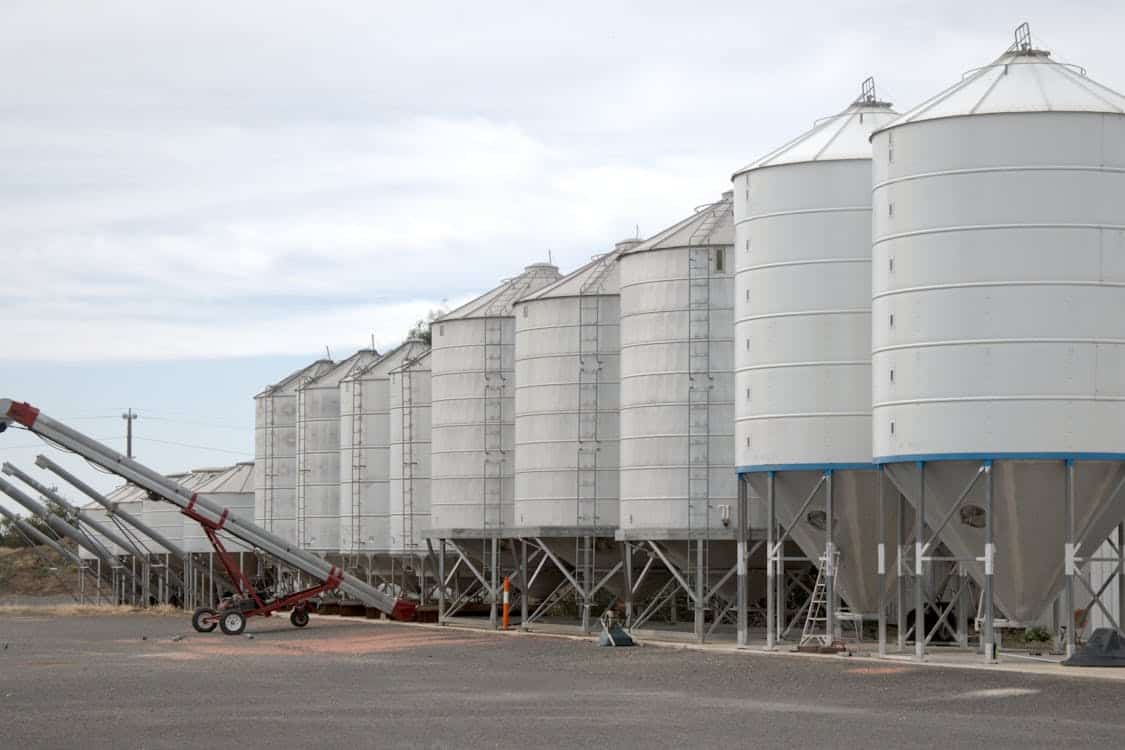
Hopper bottom silos narrow toward the base, forming a funnel that encourages gravity flow and makes full emptying simple when you need it out fast. They are typical in industrial settings where fine powders and granulated goods must be loaded into conveyors or trucks without bridging or hang ups.
The shape helps limit leftovers at the bottom, yet it requires attention to shear forces during loading to avoid compaction at the inlet. For operations with frequent turn over and strict cleanliness demands, the hopper form can save time and reduce waste.
Pneumatic Silo Storage
Pneumatic silo systems use air pressure or suction to move product from trucks or bins into the silo and to transfer it out when needed, offering contactless movement for fragile powders. They reduce manual handling and can lower contamination risks when product cannot touch many surfaces, useful in food and chemical plants.
The setup needs careful control of flow rates and filtration to avoid dust and to keep seals healthy under pressure variations. While the initial gear and controls add cost, the payoff comes with reduced labor and safer handling of fine materials.
Steel Bin Silos
Steel bin silos are modular metal cylinders that come in sizes for small farms up to huge commercial facilities, prized for quick installation and flexible capacity. They can be fitted with aeration floors and temperature monitors, which help protect stored grain from pests and damp pockets.
Steel silo systems are often favored for their strength and adaptability, providing robust, long-term storage solutions in both agricultural and industrial settings.
Corrosion protection and fastening quality are important details that dictate service life and maintenance cycles. When space and speed matter, steel bin options let operations scale up without long construction timelines.
Concrete Silo Systems
Concrete silo systems offer long term durability and thermal mass that moderates interior temperature swings, which can preserve some goods better than thinner materials. Cast in place units or pre cast panels create structures that resist impact and provide stable storage for decades when cared for properly.
Construction takes longer and requires a crew with specific skills, yet the lifecycle cost can be attractive when frequent replacement would be a burden. Owners often trade higher upfront work for predictable performance over many seasons.
Portable And Mobile Silos
Portable and mobile silos let operators move storage to where loading or unloading happens rather than hauling product to a fixed point, and they come on wheeled frames or skids. They fit seasonal operations, remote sites, or short term projects, reducing transport leg work and saving time on site logistics.
Set up tends to be quick, and removal is straightforward when the job wraps up, though capacity is smaller than permanent units. For teams that like to keep options open, mobility is a practical way to match storage to ever shifting tasks.
Aerated And Climate Controlled Silos
Aerated and climate controlled silos add fans, ducts and sensor systems that regulate temperature and moisture, giving operators a higher degree of control over product condition. They are especially useful when storing seed or fine powders that react to humidity and heat, and they help prevent spoilage and pest activity through steady environment control.
The systems require power and some automation, and routine checks make sure fans and sensors continue to work as intended. The payoff comes in longer storage life and fewer losses when conditions would otherwise run away from safe limits.
Most Recent Posts

The Format Now Sitting Above UK Car Searches Arrived as a Pilot Almost Nobody Was Invited To
Vehicle ads didn't reach British dealerships through a general release. They arrived in early 2024 as a restricted programme run with a handful of agencies, Localise among them, at a point when most of the trade had never heard of them. That's shaped who understands...
Melbourne’s January Heat Records Are Forcing a Rethink on Window Shading
Victoria hit an all-time temperature record this past January, and the number that stuck with most homeowners was not the heat itself but how long it lasted. A single scorching afternoon is manageable. A week of it, back to back, is what actually breaks air...
The Workplace Fairness Act Is Quietly Rewriting What Mindset Training Has to Deliver in Singapore
Singapore passed the Workplace Fairness Act in 2025, and by the end of 2027 it will be enforceable law, not a leadership preference. Employers with 25 or more staff — roughly 75 per cent of Singapore's employers — will be legally required to run a formal grievance...
